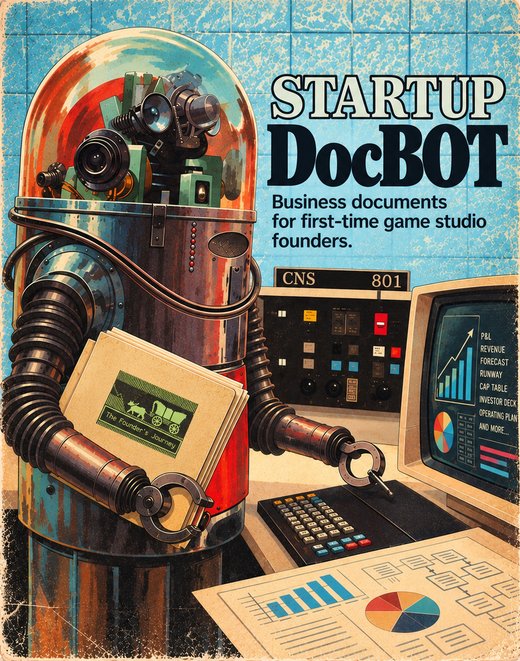
About Startup DocBot
Startup DocBot began as a series of Excel templates to enable entrepreneurs without a business background to create basic financial documents like a P&L, balance sheet, and revenue forecast. It evolved to specialize in instruments of particular use to founders of game development companies. Its latest incarnation is this web app, which I developed over the course of a semester in symbiotic collaboration with Anthropic’s Claude Fable 5.1 and Opus 5.5.
In 2025 I began teaching courses on entrepreneurship and game production with the University of Utah Division of Games, and adapted Eric Seufert’s excellent F2P Revenue Model as a sort of classroom abacus to visualize the interplay of core KPIs in free-to-play games. Despite its age (Seufert published the worksheets in 2013), the model has required surprisingly little revision to remain a valuable and relevant teaching tool. Still, I gave it a major overhaul this year to bring it in closer communion with the funnel analytics dashboards and forecasting tools our students are encountering when they enter the industry.
The next phase of development for the DocBot will merge it with these explanatory KPI models — tools for which my students have been patient and long-suffering test subjects. If all goes according to plan and Claude doesn’t bankrupt me with its appetite for usage credits, the DocBot will be a free, three-stage launch platform for lifting new game studios into stable orbits. Stage 1 gets founders off the ground with company formation documents and the quotidian legal toolbox every studio founder needs immediately. Stage 2 boosts the company through option agreements, fundraising, financial planning, and publishing. Stage 3 takes over to propel their first game with funnel analytics, revenue modeling, and cross-platform forecasting.
My goal in sharing this tool is to demystify the process of starting a game studio, especially for talented university dev teams who, with the merest nudge, could plant the sapling they germinated together as students and let its branches carry them beyond the Hieronymus Bosch landscape that is professional game development in 2026.
This project has been inspired and influenced by mentors seen and unseen, all of whom have my enduring gratitude and respect. Including but not limited to:
- Joost Van Dreunen
- Eric Seufert
- Deconstructor of Fun
- Michael Metzger
- Matthew Ball
- Dylan Collins
- David Kaye
- Frank Carrere
- Jeffrey Conrad
- Dan Winters (ave atque vale)
- Carolynn Levy, whose Y Combinator SAFE format was adopted by DocBot
- Mike Moyer, whose books were the forge molds for DocBot’s Dynamic Equity Split
- Zachary Strebeck’s “Legal Moves” blog
- The “Manatt for Entrepreneurs” newsletter (Manatt, Phelps & Phillips)
- Various newsletters, FAQs, and guides from Cooley GO, Clerky, and DLA Piper
- The students and faculty of Utah Games (games.utah.edu)